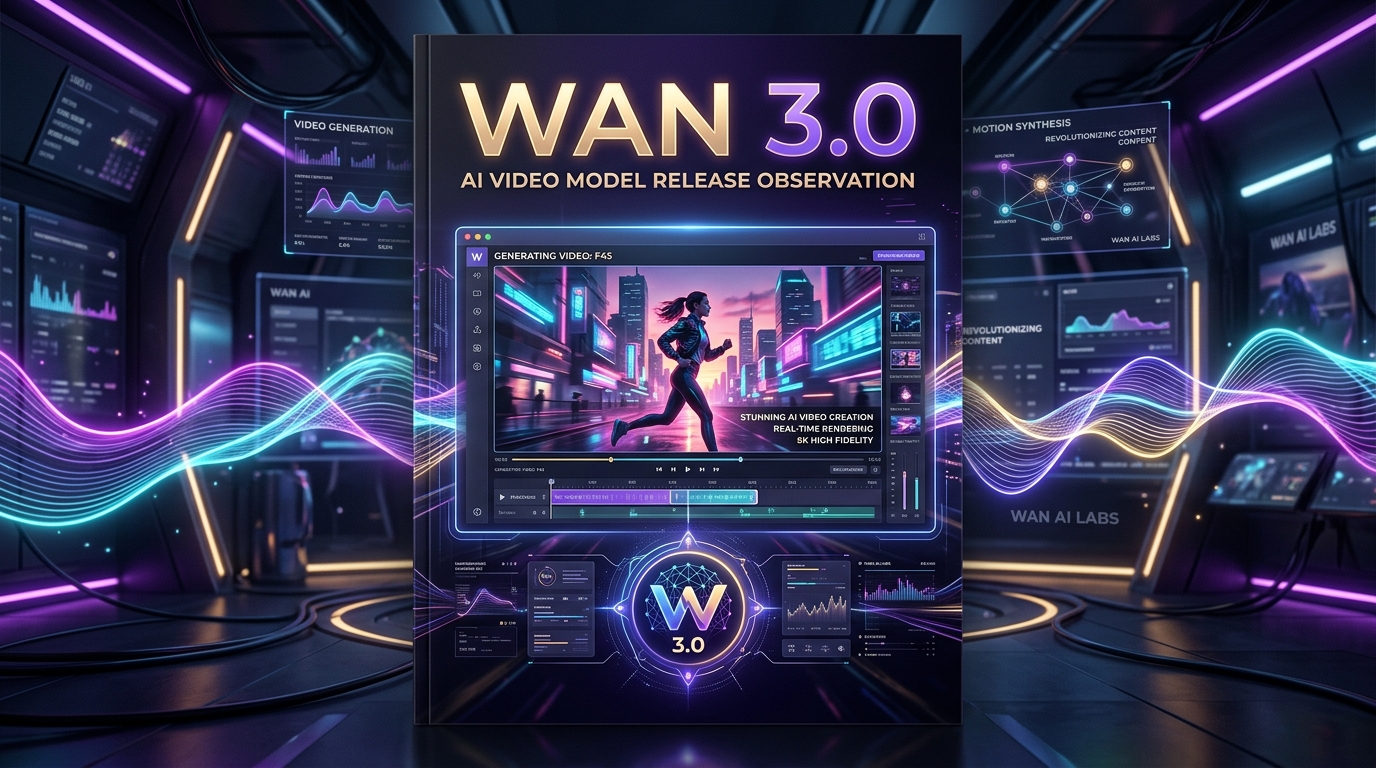
In the current AI video generation landscape, the Wan series models developed by Alibaba Tongyi Lab have garnered widespread attention from creators and developers due to their exceptional motion rendering and visual quality. Recently, discussions regarding the imminent release of "Tongyi Wanxiang 3.0 (Wan 3.0)" have become increasingly prevalent across technical communities, accompanied by unverified spec sheets and speculative launch dates.
However, as of August 2026, Alibaba has not officially announced or released "Wan 3.0" through any of its official channels. This article aims to consolidate verifiable evidence from official sources, dispel unbacked rumors circulating online, and provide clear actionable guidance for creators looking to experience or implement this technology.
Conceptual Clarification: What Is the Real Wan 3.0?
From a naming perspective, "Wan 3.0" or "Tongyi Wanxiang 3.0" serves primarily as an informal label used by search engines, media outlets, and community members to refer to Alibaba's anticipated next-generation flagship video model. Officially, Alibaba's latest available video API family remains the Wan 2.7 series launched in April 2026 (encompassing text-to-video wan2.7-t2v, image-to-video wan2.7-i2v, reference video wan2.7-r2v, and video editing wan2.7-videoedit).
During discussions, two common misconceptions often arise within the community:
- Confusing Happy Horse 1.0 with the Wan Series: In April 2026, an anonymous model named "Happy Horse 1.0" achieved top ranking on a third-party evaluation leaderboard (see CNBC coverage). However, Happy Horse represents a separate parallel research initiative by Alibaba's ATH AI Innovation Unit, and its benchmark results cannot be treated as evidence for Wan 3.0.
- Overestimating the Progress of Open-Source Weights: Alibaba's latest official open-source weights for core video generation remain at Wan 2.2, which was released in August 2025. From Wan 2.5 to Wan 2.7, subsequent core video models have been offered exclusively via cloud APIs without open weight releases.
Debunking Online Rumors: Are 4K, 30-Second Clips, and MoE Real?
With rising public interest, search results and social media have been flooded with speculative "spec sheets" claiming that Wan 3.0 features a "27B parameter MoE architecture with 14B active parameters", supports "native 4K resolution and 30-second continuous video generation", or even stating that "1.3B and 14B weights have been open-sourced under Apache 2.0".
However, thorough verification against official repositories and technical documentation reveals:
- Misconceptions on Licenses and Models: Claims regarding "1.3B and 14B open-source weights" conflate the historical release of Wan 2.1 from February 2025. Alibaba has released no open weights or license agreements associated with Wan 3.0.
- Unsubstantiated Architectural Claims: Figures regarding 27B/60B MoE architectures or native 4K/30-second outputs lack supporting official technical whitepapers. Information across search pages is self-contradictory, reflecting speculative conjecture rather than verified facts.
- Unverified Release Dates: Rumors claiming an "August 6, 2026 official launch" originate from single unverified sources and lack confirmation from Alibaba Cloud or Tongyi Lab.
In-Depth Discussion: Will Core Video Models Remain Open Source?
For developers, a critical consideration alongside performance gains is whether future model iterations will maintain an open-source strategy.
Examining historical release trajectories, Wan 2.1 and Wan 2.2 provided substantial value to the open-source AI video community. However, as subsequent models advanced in visual quality and compute requirements, core video capabilities transitioned toward cloud API monetization. In official community repository discussions (such as Wan-Video Issue #333), many developers have expressed concerns about the open-source future of core video models. Although Alibaba open-sourced the audio-driven dancing model Wan-Dancer-14B in July 2026, it serves as a specialized auxiliary tool rather than a core video foundation model.
Consequently, developers should not assume that Wan 3.0 will automatically include open-source weights upon launch. Architecture flexibility remains essential for projects with strict privacy or deployment constraints.
Practical Access: How to Use Wan 3.0 Video Generation Today
While official foundation models continue to evolve, creator demand for high-quality AI video generation remains immediate. For users seeking to utilize Wan 3.0 and the latest video generation capabilities today, there is no need to wait for complex local setups or API integrations.
If you want to use Wan 3.0, you can directly visit wan3video.art to access an online workspace. Through its intuitive web studio, you can directly generate Text-to-Video and Image-to-Video content across multiple aspect ratios, producing refined AI video clips up to ~30 seconds in length complete with synthesized audio—transforming creative ideas into polished video outputs effortlessly.
Summary and Recommended Developer Strategies
In summary, creators and developers should maintain a balanced perspective regarding Tongyi Wanxiang 3.0:
- Rely on Official Announcements: Monitor official updates from Alibaba Cloud, the Wan-Video GitHub organization, and the Wan-AI HuggingFace repository, avoiding unverified third-party rumors.
- Leverage Accessible Platforms: For active content creation, creators can utilize wan3video.art to quickly prototype ideas and streamline video production workflows.
- Maintain Architectural Flexibility: When building applications with AI video integration, keep model identifiers configurable to enable seamless upgrades when official releases occur.