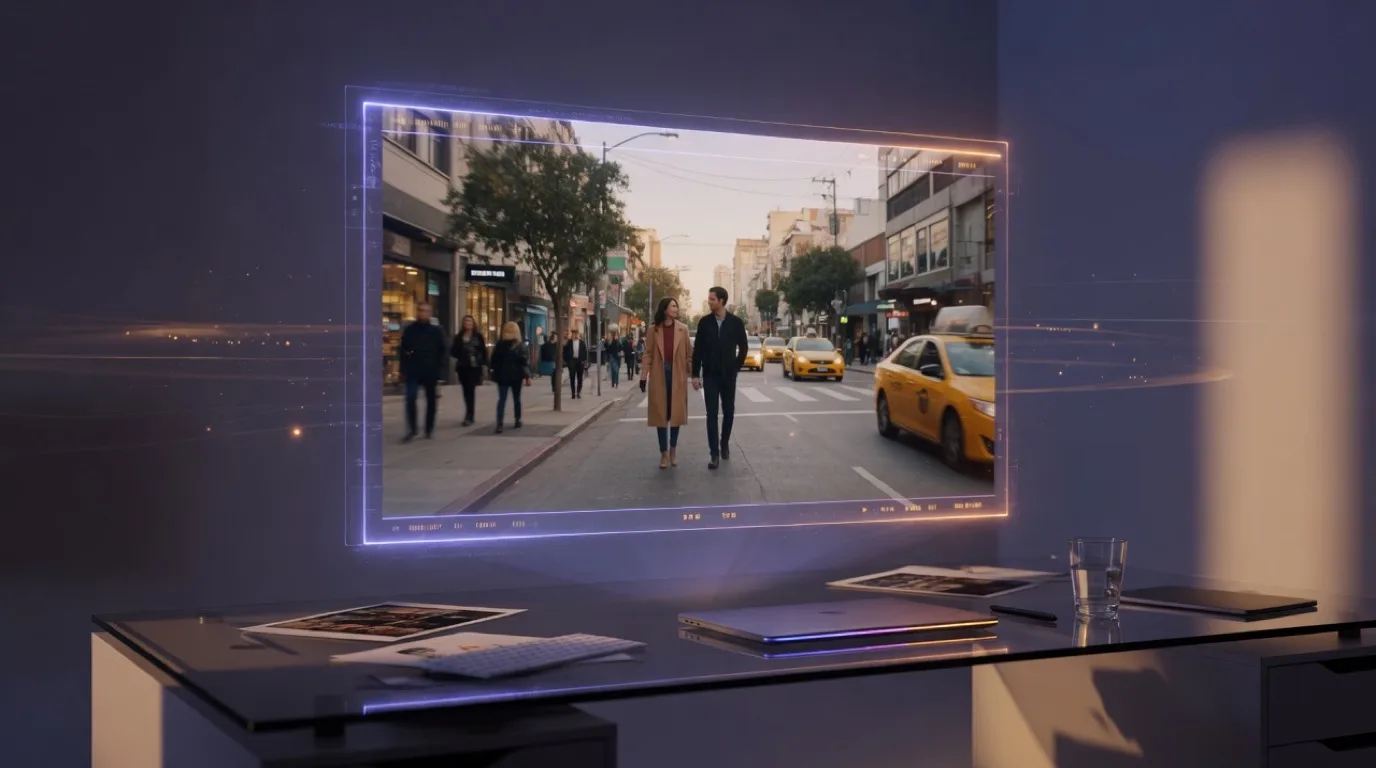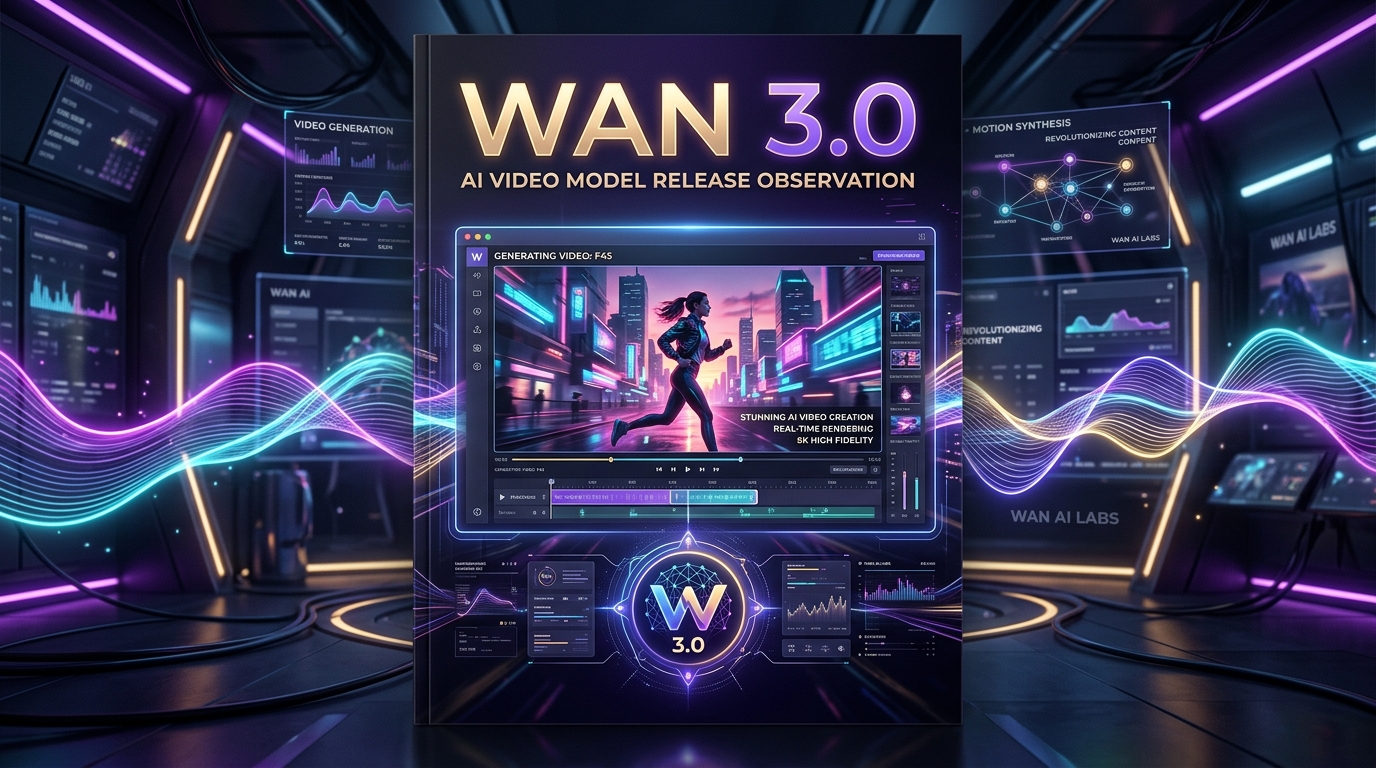
If you have been keeping an eye on the generative AI landscape over the past two years, you know how blindingly fast the video domain moves. It feels like only yesterday we were all marveling at 3-second clips of a character blinking or taking two cautious steps down a street—usually while their hands mysteriously fused into their pockets or their background melted into abstract noise. Early tools were essentially dynamic photo animators. Later iterations learned how to execute basic camera pans.
By August 2026, the entire AI video space reached a major inflection point. The industry saw a rapid cluster of releases—community channels were lively with creators comparing new models like MiniMax H3, Seedance, Flux, and the public beta debut of Wan 3.0.[^1][^2]
Developed under Alibaba’s Tongyi Lab, the Tongyi Wanxiang family (widely known simply as "Wan") has followed a distinct evolution. As tech commentators and official messaging often summarize it: Wan 1 learned to draw, Wan 2 learned to film, and Wan 3 learned to understand.[^2]
Instead of merely stitching together high-definition frames, Wan 3.0 aims to grasp context, physical realism, narrative flow, and structured data. Whether you are an independent creator, a video editor, or someone running marketing workflows, here is a complete deep dive into what Wan 3.0 offers, where it came from, how it compares to earlier models, what it costs, and where the technology still has room to grow.
Meet the Wan Family: From Open Source to Cloud Flagship
To understand why Wan 3.0 is causing such a stir, it helps to look at how the model series got here. Tongyi Wanxiang started in image generation before expanding aggressively into video synthesis via wan.video and official suite integrations.[^11]
1. The Wan 2.1 Milestone (Early 2025)
Around February 2025, Wan 2.1 hit the scene as a major open-source milestone. Released under an Apache 2.0 license, it immediately captured the developer and creator community across Hugging Face, ModelScope, and ComfyUI.[^4][^6][^13] Built on a Diffusion Transformer (DiT) architecture paired with Wan-VAE, it stood out by providing two distinct model tiers:[^5]
- 1.3B Model: Light enough to run on consumer-grade GPUs, giving individual creators local text-to-video (T2V) and image-to-video (I2V) capabilities without relying on expensive enterprise servers.
- 14B Model: Designed for higher quality generation, earning strong rankings on benchmarks like VBench at the time.
2. Wan 2.2 and the MoE Shift (Mid 2025)
By around July 2025, the team introduced Wan 2.2, ushering in Mixture-of-Experts (MoE) video architecture. With releases like T2V-A14B, I2V-A14B, and TI2V-5B, Wan 2.2 focused heavily on cinematic camera control, smoother motion trajectories, and better visual fidelity.[^7][^12]
3. Incremental Flagships: Wan 2.5, 2.6, and 2.7
As 2025 progressed, updates rolled out in rapid succession:
- Wan 2.5 (September 2025): Pushed native audio-visual synchronization, allowing videos to generate with coordinated sound effects and voice cues, usually hitting ~10-second durations at 1080p.[^8]
- Wan 2.6: Expanded multi-shot narrative control, letting users insert existing characters into brand-new scenes while retaining their identity, while stretching native clips toward 15 seconds.[^9]
- Wan 2.7: Became the primary workhorse flagship right before 3.0. It mastered text-to-video, image-to-video, multi-modal reference inputs, and granular video editing tasks, commonly discussed around the ~15-second 1080p range.[^10]
Open-Source Legacy vs. Managed Cloud Experience
While Wan 2.1 and 2.2 open weights galvanized the developer ecosystem, subsequent flagships shifted toward enterprise cloud services and API platforms.[^4][^7] For the Wan 3.0 public beta release around August 2026, the experience is primarily offered through managed platforms and hosted APIs, with official channels not releasing open model weights alongside the initial public beta launch.[^1][^3]
Deep Dive: What’s New in the Wan 3.0 Public Beta?
When official channels announced "Introducing Wan3.0 — now in Public Beta", the focus wasn't just on raw pixel counts. Instead, the update focused on real-world utility, continuous scene length, and document intelligence.[^1]
1. Native 30-Second Video Generation
The 3-to-5-second limit was long a chief complaint among AI video editors. Assembling a 1-minute video meant stitching together ten different micro-clips, which inevitably led to visual jump cuts, shifting lighting, and broken pacing.
Wan 3.0 introduces native 30-second single-pass video generation.[^1][^2] A 30-second continuous canvas gives scenes space to breathe. You can execute continuous single-take camera shots, maintain complex camera pans, or track a subject through a changing environment without artificial cuts.[^2]
To support this longer timeline, the platform includes:
- Smart Duration: The model analyzes your prompt and suggests the optimal shot length so simple actions aren't stretched out unnecessarily and complex scenes aren't cut short.[^2]
- Video Extension: If 30 seconds isn't enough to finish a narrative arc, you can extend the clip directly while preserving motion continuity, character features, and environmental lighting.[^2]
2. "Omni-Reference" & Full Document Inputs
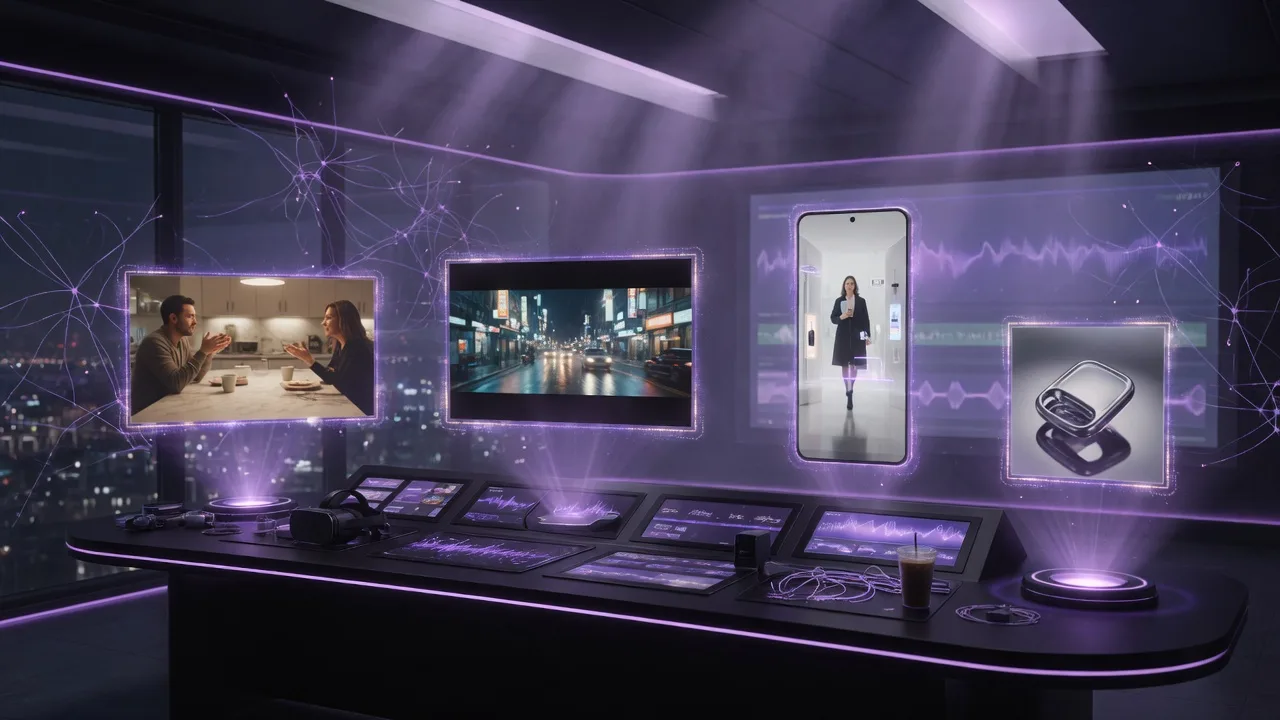
Traditionally, AI video models expect a brief string of text or a single static image. Wan 3.0 expands this into an Omni-Reference setup. You can feed the model text, images, audio, video, and—most notably—full-length documents.[^1][^2]
It officially supports .doc, .xls, .ppt, .pdf, and .md files up to 100MB and 50 pages.[^2]
Instead of copy-pasting text back and forth, the model reads through unstructured documents, slides, or markdown notes, synthesizes the narrative or technical context, and generates sequence-appropriate visual scenes.
Example Workflow: The Café Commercial Imagine a local coffee shop launching a new cold brew line. Instead of crafting 15 prompts describing the coffee beans, interior décor, and brand mood, you upload their brand overview PDF. Wan 3.0 interprets the document's vibe and automatically renders a cohesive promotional spot that aligns with the brand guide.[^2]
3. Reality-Grade Rendering and Rigid Consistency
Commercial video production demands visual consistency. If a character’s face changes, their jacket shifts color, or a brand logo warps during a pan, the clip is unusable. Wan 3.0 introduces tighter controls across several dimensions:[^1][^2]
- Diverse Characters & Micro-Expressions: The model avoids repetitive "AI-looking" faces. Characters exhibit realistic skin textures, distinct facial structures, and micro-expressions tied directly to their body language. In crowd scenes, individual characters react with unique emotional nuances rather than uniform expressions.
- Character Identity Stability: Key facial traits, body proportions, hair movement, and clothing details stay consistent across spatial shifts and continuous camera rotation.
- Prop, Logo, and Texture Integrity: Products, commercial logos, hard-surface objects, and material textures maintain their geometry and branding without visual drift.
- Spatial & Style Alignment: Scene lighting, shadow angles, camera depth, and artistic style remain locked in throughout the full 30-second runtime.
4. UI/Chart Cleanliness & Post-Generation Editing
For tech demos, software marketing, and educational videos, Wan 3.0 improves the rendering quality of digital interfaces, data charts, and screen textures.[^2] Furthermore, if a scene is almost perfect but needs a slight adjustment, you don't have to re-roll the entire prompt. The system supports direct post-generation edits to tweak visual elements, alter storyline beats, or refine dialogue timing.[^2]
Wan 3.0 vs. Earlier Generations: A Direct Comparison
To see how far the architecture has come, here is a comparison between early iterations, the Wan 2.x flagships, and the Wan 3.0 public beta:[^1][^2][^8][^9][^10]
| Feature Dimension | Early Wan (Wan 1.x / 2.1) | Wan 2.x Series (2.5–2.7) | Wan 3.0 Public Beta |
|---|---|---|---|
| Primary Goal | Single-image synthesis & basic motion ("Learned to Draw") | Cinematic camera moves & audio sync ("Learned to Film") | Contextual comprehension & full-doc synthesis ("Learned to Understand") |
| Max Native Clip Length | A few seconds | ~10 to 15 seconds | Native ~30 seconds (with Smart Duration & Video Extension) |
| Supported Inputs | Text prompt, single reference image | Text, image, audio cues, basic video reference | Omni-Reference: Text, image, audio, video + .doc, .xls, .ppt, .pdf, .md (≤100MB, ≤50 pgs) |
| Character & Prop Consistency | High chance of visual drift or morphing | Good single-shot stability; MoE architecture (2.2) | Reality-grade consistency: Multi-character micro-expressions, persistent props, exact logo geometry |
| Editing & Controls | Re-roll entire prompt | Camera control parameters, image-to-video anchors | In-line editing: Direct adjustments to screen visuals, plot details, and spoken dialogue |
| Core Production Role | Dynamic visual effects / short GIFs | Individual cinematic shots for video timelines | Document-to-video translation & complete continuous 30s narrative scenes |
Practical Use Cases for Creators and Teams
By moving from simple prompt outputs to document-driven generation, Wan 3.0 fits directly into practical workflows:[^2]
1. Store & Brand Profiles
Local businesses, agency clients, and retail brands can convert pitch decks, PDFs, or brand guideline slides directly into promo videos. Drop in a brand brief document, and the model translates core messaging into a commercial spot matching the requested visual aesthetic.
2. Product Demos and Spec Sheets
Hardware makers and e-commerce sellers can upload product spec sheets or feature tables (.xls or .pdf). Wan 3.0 reads key attributes—like material finish, dimensions, or usage scenarios—and generates dynamic product showcase clips suitable for storefronts.
3. Education and Technical Explainers
Teachers, developers, and technical writers can feed raw .md guides or lecture slides into the generator. The engine parses the technical concepts, rendering step-by-step visual explainers that keep complex information clear and engaging.
4. Multi-Format Social Content
Whether you are creating horizontal 16:9 videos for desktop displays or vertical 9:16 clips for mobile feeds like TikTok and Instagram Reels, multi-ratio output keeps framing practical for different platforms.
5. Short Dramas and Storytelling
For indie filmmakers and digital creators, native 30-second shots with tight character consistency reduce the need for constant cutting. You can direct single-take dramatic exchanges, follow subjects across scenes, and keep narrative tone intact without immersion-breaking morphing.
Ecosystem Access & Pricing Breakdown
Access to the Wan 3.0 public beta is rolling out across multiple official ecosystem entry points and API channels.
Official Access Channels
In domestic ecosystem channels, public beta access has been introduced across Alibaba Cloud Bailian, Wanjing Yike, the official Wanxiang web portal, Qwen PC, IF STUDIO, and Duiyou, alongside a grayscale rollout on the Qwen App and upcoming general API availability.[^2]
For international creators, official posts highlight access pathways via Model Studio, Qwen Cloud, and members on wan.video, with full commercial API access rolling out shortly.[^3][^11]
Public & Community-Reported Pricing
Pricing structures for Wan 3.0 API usage are based on resolution and clip duration (charged per second).
Official USD API pricing (public postings):[^3]
- 480p: ~$0.05 / second
- 720p: ~$0.10 / second
- 1080p: ~$0.20 / second
Community-reported RMB API rates (e.g., Zhidx and creator reports):[^15]
- 480p: ~¥0.3 / second
- 720p: ~¥0.6 / second
- 1080p: ~¥1.2 / second
Math example: Generating a full 30-second single pass at 1080p equates to roughly $6.00 USD (or approximately ¥36 RMB based on Chinese tech community figures).[^3][^15]
Creator feedback—such as notes from digital creator Guicang (归藏)—points out that while 1080p generation costs require budget planning for multi-take projects, the model's Omni-Reference capabilities make it exceptionally friendly for automated Agent workflows, video texturing, and complex multi-modal prompting.[^14]
Realistic Expectations: Current Limitations
While Wan 3.0 represents a major technical leap forward, no generative model is perfect. Understanding where the edges lie helps avoid wasted credits and unexpected results.
- Audio and Text Quality: During the current public beta, audio quality and on-screen text accuracy still have room to improve. If your production demands crisp typographical logos, exact rendered text callouts, or studio-grade pristine dialogue, you should plan to refine those elements using standard post-production tools.[^2]
- Generative Probability: AI video generation runs on complex statistical models. High consistency does not mean zero errors. Hands, intricate overlapping objects, or hyper-fast actions can still produce occasional artifacts. Generating a few variations before picking a final cut remains standard practice.
- High-Res Cost Management: Because generation is billed per second per pixel tier, running iterative experiments at 1080p can add up quickly. Running initial draft takes at 480p or 720p before rendering your final master at 1080p is a smart way to manage your render budget.[^3][^15]
How to Get Started with Wan 3.0
If you want an accessible studio environment to start testing text-to-video, image-to-video, and document-to-video workflows without complicated code configurations, check out WAN 3.0 Video Studio.
The web workspace at https://wan3video.art/ lets creators experiment with:
- Text-to-Video & Image-to-Video: Turn text ideas or static reference art into moving scenes.
- Multi-Aspect Ratio Controls: Frame horizontal widescreen layouts for classic displays or vertical aspect ratios for mobile social channels.
- ~30-Second Audio-Visual Generation: Test native long-duration storytelling with synchronized sound directly in your web browser.
Summary
The launch of Wan 3.0 reflects a broader transformation across the entire AI landscape. The technology has evolved beyond generating simple, short visual novelties into building tools that understand documents, complex real-world physics, brand identities, and long-form continuous takes.[^1][^2]
While audio quality and on-screen text accuracy still have room to improve, the ability to feed a multi-page PDF or slide deck into an engine and receive a cohesive, 30-second video with stable character identities is a major step for digital production.[^2]
Give your text prompts, reference images, and brand briefs a spin at https://wan3video.art/, and see how 30-second, document-aware AI video fits into your creative pipeline!
References
[^1]: Wan (@Alibaba_Wan), “Introducing Wan3.0 — now in Public Beta,” X, Aug 6, 2026. https://x.com/Alibaba_Wan/status/2085339761284104529
[^2]: Alibaba, “更懂真实世界,Wan3.0开启公测” (Wan 3.0 Public Beta announcement), WeChat Official Account. https://mp.weixin.qq.com/s/MQeQm2xOiNc3_zIK9WZqLA
[^3]: Wan (@Alibaba_Wan), Wan3.0 public beta access & API pricing (USD), X, Aug 6, 2026. https://x.com/Alibaba_Wan/status/2085339765860364601
[^4]: Alibaba Group, “Alibaba Cloud Open Sources its AI Models for Video Generation,” Feb 26, 2025. https://www.alibabagroup.com/en-US/document-1831486012178563072
[^5]: Wan Team, Alibaba Group, “Wan: Open and Advanced Large-Scale Video Generative Models,” arXiv:2503.20314, 2025. https://arxiv.org/abs/2503.20314
[^6]: Alibaba Group, “Alibaba Unveils its Latest Open-Source Video Generation Model,” Apr 18, 2025. https://www.alibabagroup.com/en-US/document-1851424828087599104
[^7]: Alibaba Cloud, “Alibaba Releases Wan2.2 to Uplift Cinematic Video Production,” Jul 29, 2025. https://www.alibabacloud.com/en/press-room/alibaba-releases-wan-2-2-to-uplift-cinematic
[^8]: Wan (@Alibaba_Wan), “Today, we're officially launching Wan2.5-Preview!” X, Sep 24, 2025. https://x.com/Alibaba_Wan/status/1970697244740591917
[^9]: Wan (@Alibaba_Wan), “Introducing Wan2.6,” X, Dec 16, 2025. https://x.com/Alibaba_Wan/status/2000930078037827972
[^10]: Alibaba Cloud Model Studio, “Wan2.7 - Text-to-Video API Reference.” https://www.alibabacloud.com/help/en/model-studio/text-to-video-api-reference
[^11]: Wan AI official site. https://wan.video/
[^12]: Wan-Video on GitHub. https://github.com/Wan-Video
[^13]: Wan-AI on Hugging Face. https://huggingface.co/Wan-AI
[^14]: 歸藏 / Guicang (@op7418), Wan 3.0 public beta community notes, X, Aug 6, 2026. https://x.com/op7418/status/2085370072332452212
[^15]: 智东西 / Zhidx (@Chinazhidx), “Alibaba Wan3.0 AI video generation model is now open for public beta,” X, Aug 6, 2026. https://x.com/Chinazhidx/status/2085360869089939487